

The sound of a saxophone takes shape at the instrument, the mouthpiece and the reed, and of course in combination with the player. Munich-based saxophonist Thorsten Skringer has refined this chain over decades and knows exactly how he wants to sound. The microphone adds one more element that shapes his unique tone. It is the last link before the mixing console. For a long time, it was also the only one he didn’t bring himself: at live shows, he had to use whatever was on hand. For several years now, he has always brought the SCHOEPS Saxophone Set along.

Accordingly, he has clear expectations of this final piece of the puzzle. “The requirement for a microphone is, of course, to translate my own sound as faithfully as possible, one to one, the way I hear myself,” he explains.

Skringer won the Yamaha European Sax Contest in 2004 and has been a Yamaha Artist ever since. In 2009, he joined the heavytones, the eight-piece band led by Wolfgang Dalheimer that has shaped live music on German television for around 25 years. In 2011, he founded his own saxophone camp in the Bavarian Forest, Saxcamp Skringer, which he still runs every year. Since 2023, he has also toured with Herbert Grönemeyer as the solo saxophonist.

As different as these activities are, they share one common thread: Skringer usually plays in very loud bands, using in-ear monitoring, and in situations where his sound has to be spot-on from the very first note.
The Demands of a Live-to-Tape Production

With the heavytones, the mix is created during the taping of the TV show. The band works with its own sound engineer, who delivers the stereo mix directly to picture. What’s on tape is what airs. “There’s no way to tweak afterward,” says Skringer.

The sheer scale of TV production shows why fixing things later would hardly be practical anyway. For the Sat.1 show “Let The Music Play,” the band played three tapings a day in a modified lineup, each with 35 titles, for more than 100 songs daily. “If we had started mixing all of that from scratch, we would have been mixing for months,” he says.

The band has also made a deliberate decision against what has become common practice. In many productions today, live music bands are supported by playback tracks from a computer. “We’re still eight musicians simply playing our instruments live, and nothing else is running,” says Skringer.

The stage situation in a TV studio is extremely tight. Drums and percussion are set up less than a meter away. In-ear monitoring is mandatory, if only because the director’s cues come through the monitoring system as well. “Managing bleed is our daily business, of course,” he says.

A First Encounter with SCHOEPS

Skringer’s first encounter with SCHOEPS grew out of exactly this problem. In 2021, the heavytones taped a 90s-themed show with the legendary German TV host Thomas Gottschalk in Baden-Baden, in which Skringer had a prominent clarinet feature. The clarinet is difficult to capture in a pop music context to begin with, and his channel picked up too much of everything else. An engineer from the live sound company offered him a capsule he had used successfully as an overhead microphone for orchestral instruments.

“That was eye-opening,” Skringer recalls. “The SCHOEPS name had always been on my radar, but once you experience it in the middle of a production, right there on the spot, what a difference it makes to the sound, that fascination with the sound quality is there to stay.”

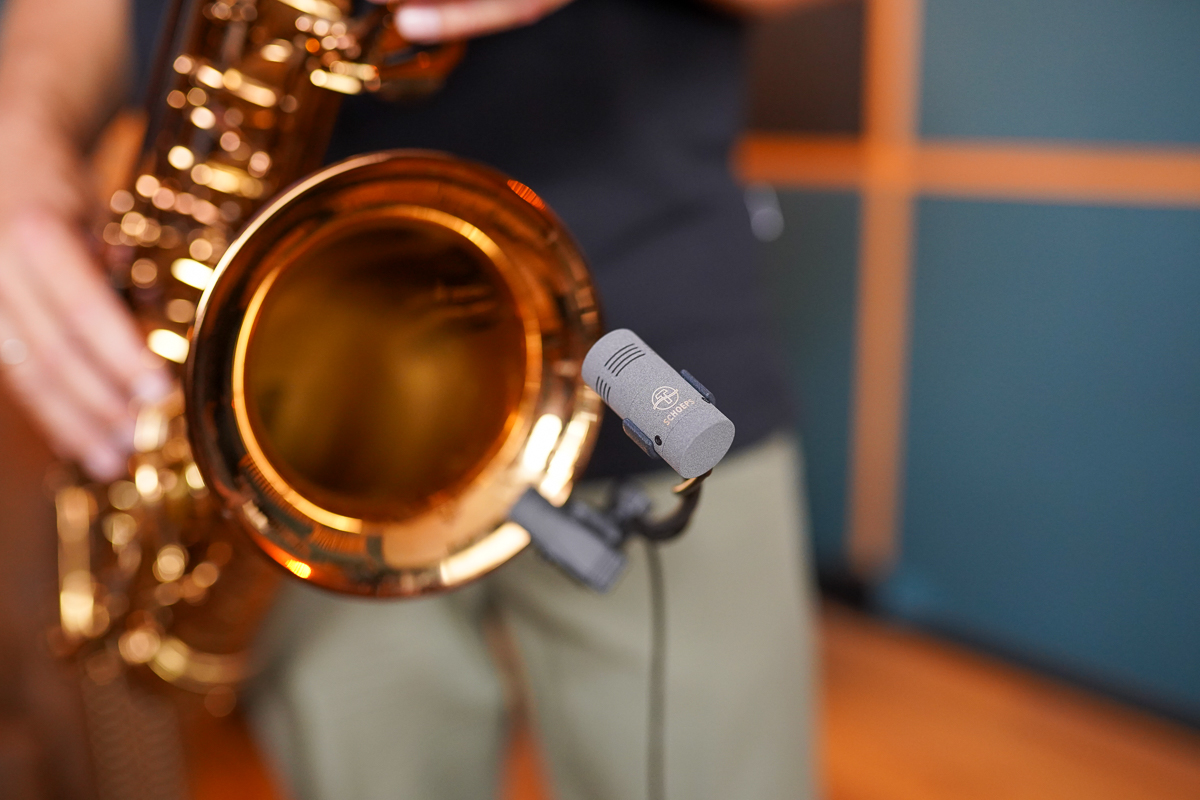
Shortly afterward, he had the chance to try the same microphone on saxophone. The mounting proved decisive: the BA 20 instrument adapter clamps the microphone directly and securely to the bell, instead of positioning it on a stand. Since then, Skringer has played the same combination on all of the heavytones’ TV productions: a SCHOEPS MK 41 supercardioid capsule on a CMC 1 KV, mounted with the BA 20 instrument adapter.


Resolution and Separation

“The MK 41 capsule with the CMC 1 amplifier has incredibly high resolution,” says Skringer. “You get exactly that brilliance in the overtones, which is where you like to hear the saxophone cut through in our context, and at the same time excellent separation from the noise happening around me.”

For him, it’s the combination that makes the difference: “That’s what is so impressive about this capsule. It provides incredibly fine resolution, yet it leaves me remarkably alone on my channel, with my track and my sound.”

In Skringer’s everyday work, bleed is a critical issue. The obvious response, simply turning up the saxophone in the mix, only gets you so far. “Because at some point you’re also turning up the drums and percussion along with it.” The better the isolation of his own instrument and the stronger the rejection of bleed, the more Skringer can focus on his musical delivery.

For the engineers, this means less work on the signal. On horns, they routinely set a low cut at 80 Hz to avoid key noise, but beyond that the channel remains largely untouched. “As far as I can tell, the engineers mostly run the microphone flat, without any major tonal adjustments,” says Skringer. “At most a slight cut up top, but that’s it.”


The Impact on In-Ear Monitoring

The most revealing benefit shows up in his monitoring. “The biggest impact on my monitoring is actually that I need two or three dB less of my saxophone in my in-ears, because I can still hear myself clearly at a slightly lower level.”

What sounds like a small difference has a major effect on ensemble playing. Musicians who struggle to hear themselves turn themselves up, and those who turn themselves up lose the connection to the rest of the band. “You lose a bit of your time with the drums, your tuning with the piano, the blend within the section,” says Skringer. With his own instrument at a lower volume in his ears, the horn section’s balance stays intact.

On top of that, the sound of a wind instrument is hard to judge on in-ear monitors in the first place. Because of the occlusion effect (an acoustic phenomenon caused by in-ear headphones partially sealing the ear canal, which overemphasizes the low frequencies of one’s own instrument), Skringer hears himself differently from how he actually sounds. He describes it as a “triangular relationship you constantly have to reassess. Is it me as a player? Is it my reed? Is it my mic, or is it my in-ear sound?” A microphone whose behavior he intimately knows takes one variable out of the equation.

The same applies when Skringer goes to push hard for a solo: “I can really go to the absolute peak of my volume when I play, and I never feel that the microphone lets me down or limits me.”

The BA 20 and Microphone Positioning

The angle at which the capsule sits on the bell audibly changes the sound. “Whether I turn the microphone a little more towards the upper keys or a little more towards the bell, it all changes the core of the sound slightly.”

This makes the mount’s stability a sonic factor in its own right. A clamp that gives or wobbles loses the position once it has been found. “It’s really important to me that the best-sounding position on the bell, and the angle to the instrument, are held in place.”

In Skringer’s experience, this is exactly where clip-on solutions fall short in practice. Some designs, he notes, are deliberately built to be flexible in order to avoid key noise. With another manufacturer, the problem lies in the design itself: “They made the principle of the clamp and the mount far too complicated, and then the microphone keeps slipping out of place. I have no use for a mic like that if it doesn’t hold its position.”

He is precise about his expectations for a great microphone clip: “There are several small criteria that are important: the quality of the clamp, its stability, the positioning of the microphone. SCHOEPS has solved this at a level of quality I don’t know from any other manufacturer. Not a single one.”

Skringer also finds it remarkable that this firmness does not translate into key noise: “I don’t know how SCHOEPS managed to keep key noise so well under control, even though the mount feels very firm.”


His Own Microphone on Stage

A horn player bringing his own microphone is by no means a given on productions. “There have been situations where you’re on a production, the company supplying the equipment on site puts microphones out for us horn players, and they turn their noses up a bit when you mention you’ve brought your own. Not always, but it has happened,” says Skringer.

On several occasions, this led to a direct comparison. “For example, people would say: fine, let’s try it, let’s compare. And in those situations, so far, all the engineers have unanimously chosen the SCHOEPS, especially in my case on saxophone. Even die-hard fans of the microphones they always use as standard had to admit that it sounds incredibly good.”

His reservations about other clip-on solutions are practical in nature. In very loud bands, a voicing designed for immediate appeal backfires: “If the microphone pushes the highs too much so that a player likes it when first trying it out, you sometimes have the problem that it’s extremely prone to feedback.”

The effort at the console differs as well. When Skringer works with a clip-on microphone supplied by a production, he and the monitor engineer have to “tweak and filter forever, just so I feel somewhat comfortable.” For him, bringing his own microphone therefore means, above all, keeping the last element of the signal chain in his own hands instead of giving it up at the side of the stage.


Little Big Beat Studio: Freedom of Movement in the Studio

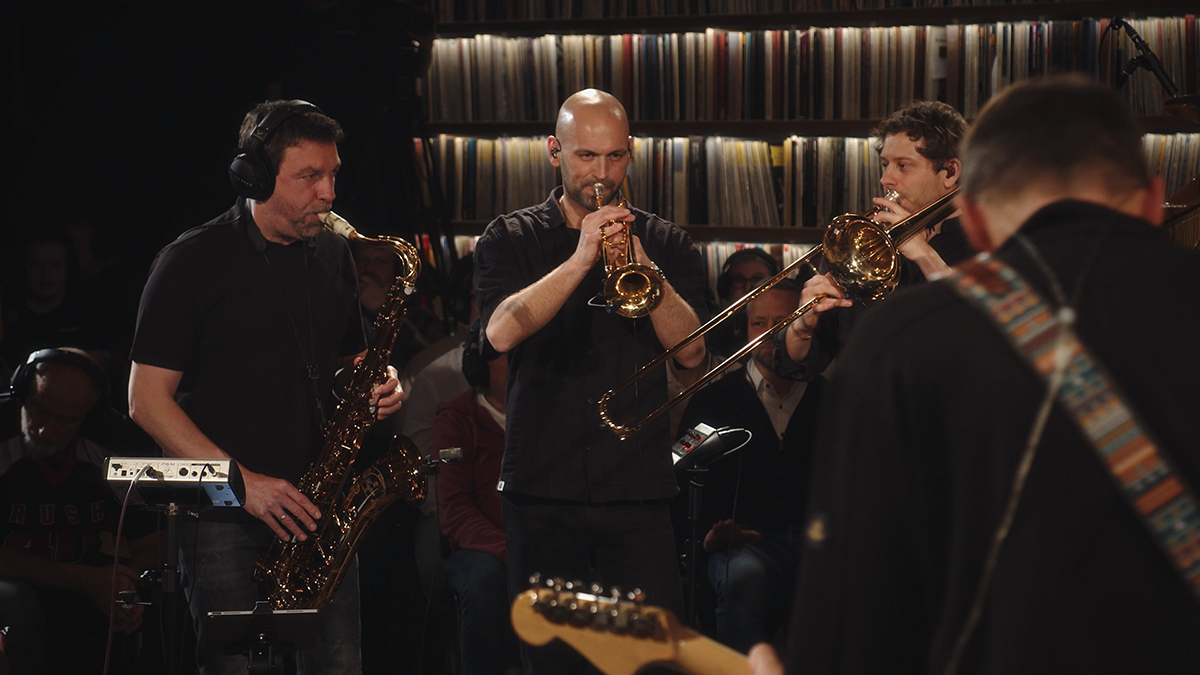
In March 2026, the heavytones made what they consider their most important recording to date: a double LP, played live to analog tape at Little Big Beat Studio in Eschen, Liechtenstein, with an audience in the room. There, too, Skringer played the MK 41, on the studio’s explicit recommendation. “I hadn’t tried it on saxophone before, but if you want to move around, I don’t have anything better here in the studio,” studio owner Manfred “Little” Konzett told him.

On recordings that thrive on a live atmosphere, Skringer does not want to be held back. “I don’t want to have to restrain myself: ‘Oh, I can’t move, because then I’ll have a different angle to the microphone setup.’” He describes himself as someone who moves a great deal while playing.

A Permanent Part of the Setup

Across TV studios, rehearsal rooms and recording studios, the SCHOEPS Saxophone Set always comes along. “Humans are creatures of habit, and I’m the chairman of the board of creatures of habit,” says Skringer. “Better safe than sorry. I like to always have something with me that I know works.”

Following the release of the double LP from the Studio Live Session at Little Big Beat Studio, the heavytones head out on their 25th anniversary tour from November 2026 through the end of January 2027.

Learn more about Thorsten Skringer: http://www.skringer.de/


Die vorgestellten Produkte